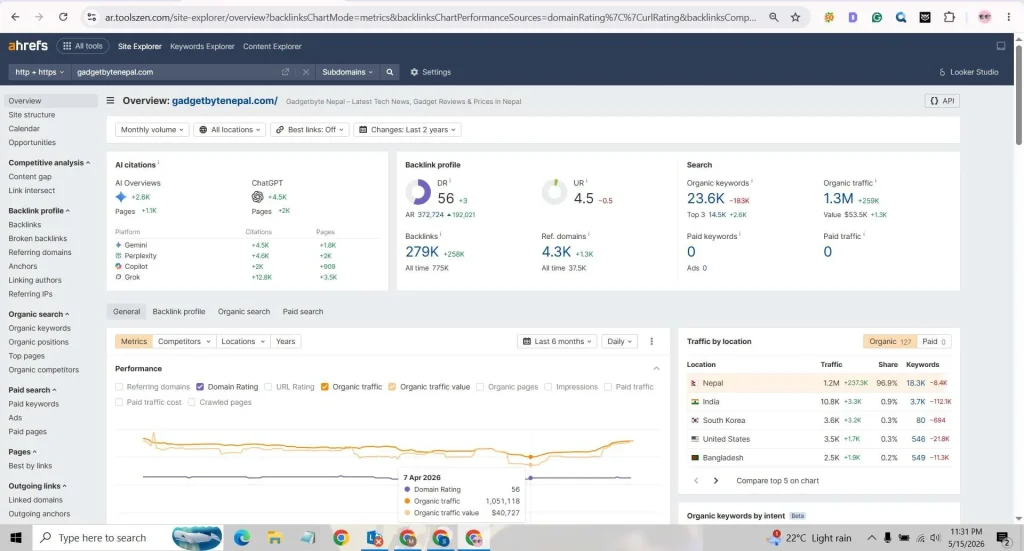
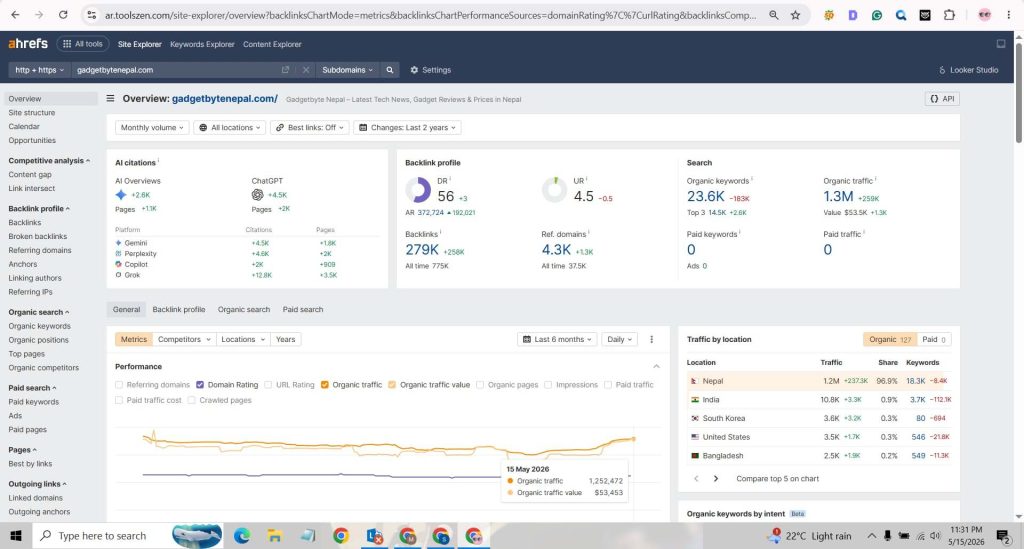
In just one month, I helped increase GadgetByte Nepal’s organic traffic by over 200,000 visits and boosted its traffic value by approximately $13,000, according to Ahrefs.
At the time, GadgetByte Nepal was already a recognized tech media website in Nepal, but there were major technical SEO bottlenecks, crawl inefficiencies, ranking opportunities, and content structure issues preventing faster growth.
Instead of relying on one “magic trick,” I focused on rigorous daily SEO execution – fixing technical debt, improving crawlability, restructuring content opportunities, cleaning indexation issues, and strengthening keyword targeting.
By May 15, the results started reflecting clearly in Ahrefs:
- Organic Traffic: ~+237K increase
- Traffic Value: ~+$13K increase
- Stronger organic visibility across Nepal
- Higher rankings for valuable commercial and informational keywords
The Challenge
When I started aggressively optimizing GadgetByte Nepal, the website had several SEO inefficiencies that were quietly holding back growth.
Some of the biggest issues included:
- Broken internal and external links
- Redirect chains and redirected internal URLs
- Crawl waste caused by filter URLs and parameter pages
- Fake pagination and homepage canonicalization issues
- Soft 404 pages
- Weak keyword targeting for category pages
- Orphan URLs and internal linking gaps
- Under-optimized category structures
- Missed ranking opportunities against competitors
The challenge wasn’t just growing traffic.
The challenge was doing it without damaging an already large site, while improving long-term SEO health.
My SEO Strategy
I approached the growth using four major pillars:
1. Technical SEO Cleanup
My first priority was reducing crawl inefficiencies and technical errors.
I performed extensive technical audits and worked closely with developers to solve issues affecting crawling and indexing.
Key fixes I worked on:
Search URL & Crawl Management
I audited search and parameter-based URLs and identified unnecessary crawlable pages.
I recommended:
- Blocking filter and parameter URLs in robots.txt
- Preventing crawl waste from low-value pages
- Fixing fake pagination problems
This helped search engines focus crawl budget on pages that actually mattered.
Canonical & Redirect Fixes
I discovered problematic canonical behavior where some URLs were redirecting or canonicalizing incorrectly.
I worked on:
- Removing incorrect homepage canonicals
- Fixing 404-page redirect behavior
- Solving redirect chain problems
- Updating redirected internal URLs
- Cleaning leftover incoming backlink URLs
Redirect chains and poor canonical signals can dilute ranking signals. Cleaning these up improved SEO clarity.
Broken Link Cleanup
I rigorously updated:
- Broken internal links
- External 404 links
- Redirected URLs
This reduced technical friction and improved site quality signals.
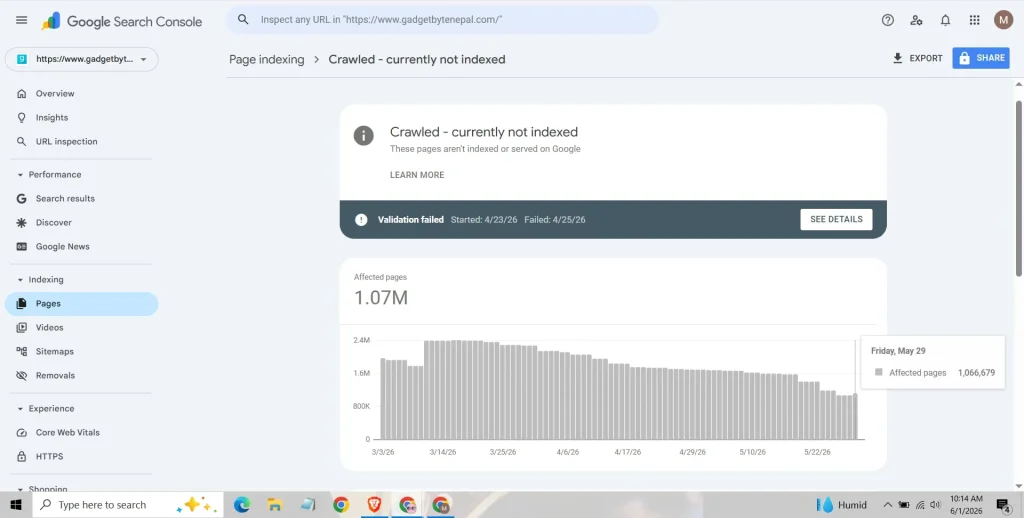
Soft 404 & Noindex Audits
I audited:
- Soft 404 pages
- “Excluded by noindex” pages
- Alternate canonical pages
The goal was simple:
Make sure valuable URLs are indexable and low-value URLs stay out of Google.
2. Category Page SEO Optimization
One of the biggest growth levers I identified was category page optimization.
Instead of treating category pages as basic archives, I turned them into SEO assets.
I conducted deep keyword research using:
- Ahrefs
- Semrush
- Competitor gap analysis
I researched and finalized keyword opportunities for:
- Mobile phones
- Laptops
- TV-related categories
- Brand/category-specific pages
What I improved:
- Better primary keyword targeting
- Category keyword mapping
- Improved content structure planning
- SEO-focused content hierarchy
- Ranking-focused optimization opportunities
For example, I researched and planned keyword structures for important commercial pages like:
- Mobile phone categories
- Laptop categories
- Brand-specific sections
This created stronger topical relevance and improved ranking potential.
3. Competitor & Keyword Gap Analysis
I didn’t optimize blindly.
I continuously analyzed competitors and identified keyword gaps.
I researched competitors like:
- TechPana
- TechnologyKhabar
Then I identified:
- Keywords competitors ranked for
- Pages GadgetByte could improve
- Ranking opportunities with higher traffic potential
I also performed bulk keyword analysis using Semrush and manually reviewed thousands of keywords to prioritize pages with the strongest upside.
This helped shift efforts toward pages with real ranking and traffic potential instead of vanity SEO work.
4. Content-Level SEO Improvements
Beyond technical fixes, I also worked on improving content-level SEO signals.
This included:
- Keyword research for writers
- Content structure planning
- Missing title tag improvements
- Ranking page optimization
- Internal linking opportunities
- Orphan URL analysis
I also reviewed pages that were underperforming and created plans to improve their rankings.
The focus was not just on publishing more content.
It was on making existing content perform better.
Results (By May 15)
After rigorous execution and continuous daily SEO work, the growth became visible in Ahrefs.
Organic Traffic Growth
Organic traffic increased by roughly 200,000–237,000 visits within a month.
Traffic grew from approximately 1.05M to 1.25M+ monthly organic visits.
Traffic Value Growth
Traffic value increased by around $13,000, showing that rankings improved not only in quantity but also in keyword quality.
This meant GadgetByte Nepal was earning visibility for higher-value keywords, not just low-intent traffic.
Stronger SEO Foundation
Beyond short-term traffic gains, the website became technically healthier through:
- Better crawl efficiency
- Cleaner redirects
- Reduced technical debt
- Stronger category optimization
- Better keyword targeting
- Improved internal SEO structure
What I Learned
This experience reinforced something important:
Large SEO wins usually come from consistent execution, not shortcuts.
The growth didn’t happen because of one viral article or one backlink.
It happened because I consistently worked on:
- Technical SEO
- Crawl optimization
- Indexation fixes
- Keyword research
- Category page optimization
- Competitor analysis
- Link cleanup
- Content structure improvements
every single day.
Final Takeaway
Growing an established media website like GadgetByte Nepal required balancing technical SEO, content strategy, and site-wide optimization simultaneously.
By systematically fixing SEO bottlenecks and prioritizing high-impact tasks, I was able to help increase:
+200,000 organic traffic
+$13,000 traffic value
within a month — while also building a stronger long-term SEO foundation for sustained growth.
This wasn’t luck. It was rigorous SEO execution.