Some SEO projects are straightforward.
You optimize pages, publish content, build links, and slowly grow traffic over time.
But Mobilemandu was different.
When I joined the project in May 2025, the website had already gone through a major platform migration to Next.js. While the new setup looked modern from the development side, it created several SEO and indexing problems behind the scenes.
Traffic momentum had slowed down, indexing issues were appearing constantly, and the overall site structure wasn’t fully optimized for long-term organic growth.
At that point, I knew this project wouldn’t just require “basic SEO.”
It needed technical problem-solving, strategic planning, collaboration with developers, UX thinking, and a system that could scale content and authority at the same time.
This case study is about how I approached that challenge and helped Mobilemandu regain its momentum.
Understanding the Situation First
Before touching anything, I spent time auditing the entire website.
I didn’t want to jump directly into rankings or backlinks without understanding what was actually stopping the site from growing.
The more I analyzed the website, the clearer the problems became.
The migration had created several technical SEO issues that were affecting how search engines were crawling and understanding the website.
At the same time, the site structure itself needed improvement.
The website had potential, but it lacked a strong SEO foundation.
So instead of trying random fixes, I decided to approach everything systematically.
The Major Problems I Found
After completing the audit, I categorized the issues into two major areas:
Technical SEO Problems
This was the biggest challenge in the beginning.
I found issues related to:
- Preferred domain conflicts
- Sitemap problems
- Status code errors
- HTML rendering inconsistencies
- Crawlability issues
- Indexing inefficiencies in Google Search Console
Because the website was JavaScript-based, technical SEO became even more important. If search engines struggle to properly render or understand pages, rankings become much harder to sustain.
Structural & On-Page Problems
The second issue was the site structure itself.
The website needed:
- Better category organization
- Stronger brand page structure
- Proper internal linking
- Improved topical relevance
- Better UX flow for users
- More scalable content planning
I realized that simply fixing technical errors wouldn’t be enough. The entire website needed a more organized SEO structure.
Building the Strategy
Once I understood the problems, I created a step-by-step execution plan.
Since our team was small, proper planning was extremely important.
At that time, the SEO team was basically:
- Me handling SEO strategy and execution
- Two content writers supporting content production
That meant every decision had to be efficient and high impact.
So I divided the project into phases:
- Fix the technical SEO foundation
- Stabilize indexing issues
- Rebuild the site structure
- Improve UX and conversion flow
- Scale content strategically
- Build authority through outreach and backlinks
This gave us a clear direction instead of trying to fix everything randomly at once.
Fixing the Technical SEO Problems
The first month was heavily focused on technical cleanup.
I started solving:
- Preferred domain URL issues
- Sitemap errors
- Broken status codes
- HTML structure problems
- Indexing inconsistencies
At one point, I was spending hours daily inside Google Search Console trying to understand why certain pages weren’t behaving correctly after migration.
This phase taught me how important technical SEO really is — especially for JavaScript-based websites.
A lot of people focus only on content and backlinks, but if the technical structure is weak, growth becomes unstable.
After stabilizing the technical side, I continued improving indexing problems for the next couple of months until the website became much healthier overall.
Rebuilding the Site Structure
Once the technical issues were under control, I shifted focus toward the website architecture.
This was one of the most important improvements in the project.
I started planning:
- Category pages
- Brand pages
- Product page relationships
- Internal linking systems
Instead of creating disconnected pages, I implemented a SILO structure to strengthen topical relevance across the website.
This helped search engines better understand the relationship between pages while also improving user navigation.
Slowly, the website started feeling more organized — not just for Google, but for actual users too.
Working Closely With Developers & Designers
One thing I genuinely enjoyed about this project was the collaboration.
SEO wasn’t isolated from development or design.
I had regular discussions with developers and designers about:
- UX issues
- Navigation improvements
- Layout adjustments
- Conversion-focused elements
- Page performance improvements
I believe modern SEO works best when technical SEO, UX, and content strategy all work together.
And honestly, some of the best improvements came from these collaborative discussions.
Scaling Content Without Sacrificing Quality
Content production was another challenge.
Since we had a very small team, scaling content manually at a large level would have taken a very long time.
So I built a humanized AI-assisted content workflow.
And to be clear — the goal was never to spam AI-generated content.
Instead, I used AI strategically to speed up research, outlines, and production processes while keeping human editing and optimization at the center.
This allowed us to:
- Publish optimized category pages faster
- Build stronger brand pages
- Improve topical coverage
- Maintain publishing consistency
- Scale content more efficiently
This system helped us move much faster without lowering content quality.
Starting the Outreach & Link Building Campaign
Once the technical and structural foundation became stable, I started focusing more aggressively on authority building.
I planned and executed:
- Link-building campaigns
- Outreach strategies
- Influencer PR collaborations
Over time, the website’s authority started improving significantly.
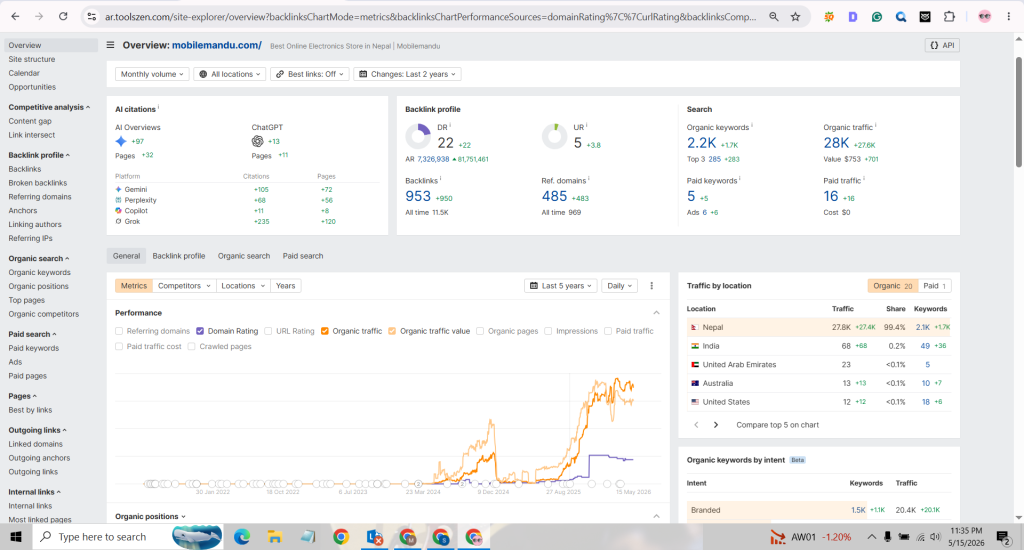
One of the biggest milestones was increasing the Domain Rating from 2 to 26 within a relatively short period.
That improvement played a huge role in helping the site compete more strongly in search results.
Improving UX & Conversion Rate
One thing I always think about during SEO projects is this:
Traffic means nothing if users don’t convert.
So while working on rankings and traffic growth, I also focused heavily on user behavior.
Using tools like Google Analytics and Microsoft Clarity, I studied:
- User navigation patterns
- Drop-off points
- User interaction behavior
- Conversion flow problems
Based on the data, I worked with the team to implement several UI/UX improvements across the website.
These changes helped improve:
- Product discovery
- User engagement
- Shopping experience
- Purchase conversion rate
And after a few months, we started seeing measurable improvements not only in traffic but also in conversions.
When the Momentum Finally Started Coming Back
The first couple of months were honestly intense.
A lot of technical cleanup was happening in the background, and results weren’t immediate.
But gradually, things started changing.
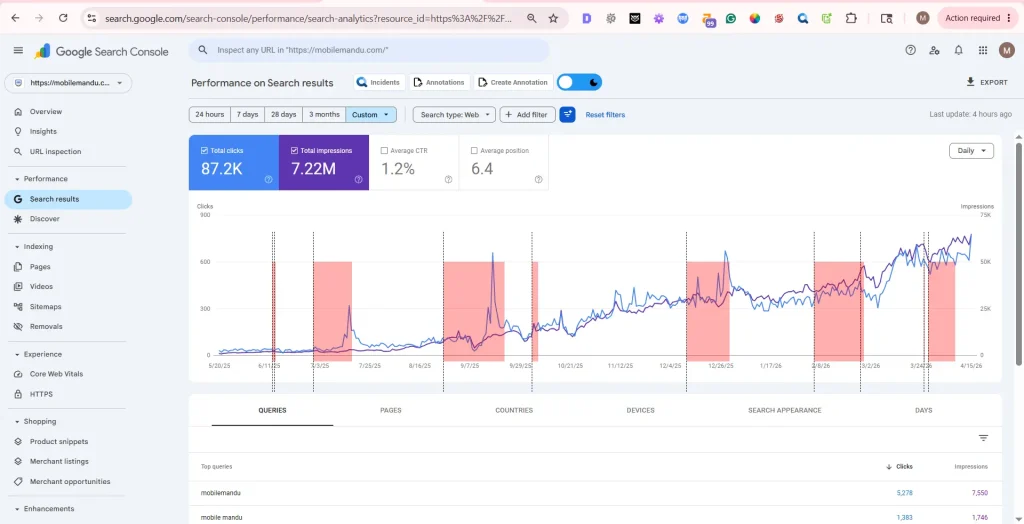
The website began recovering its traffic momentum.
Then traffic value started increasing.
Keyword visibility improved.
Indexing became more stable.
More pages started performing consistently.
And eventually, the entire growth curve started accelerating upward.
That was probably the most satisfying part of the project — seeing all the small improvements finally compound together.
What This Project Taught Me
Mobilemandu taught me that SEO is much more than rankings.
It’s about:
- Solving technical problems
- Understanding user behavior
- Building scalable systems
- Coordinating with teams
- Improving conversions
- Creating long-term growth foundations
This project also improved my confidence in handling technically complex SEO situations, especially for JavaScript-based websites and post-migration recovery.
Tools I Used Throughout the Project
Throughout the campaign, I continuously monitored data using:
- Google Search Console
- Google Analytics
- Microsoft Clarity
- Ahrefs
- SEMrush
These tools helped me track:
- Organic traffic growth
- Indexing health
- User behavior
- Keyword rankings
- Traffic value
- Technical performance
Final Thoughts
Looking back, Mobilemandu became much more than just another SEO project for me.
I was deeply involved in almost every aspect of growth — from technical troubleshooting and strategy building to content systems, UX improvements, outreach, and conversion optimization.
The project is still growing, and I’m still actively improving different components to maintain long-term sustainability.
But one thing this experience reinforced for me is that real SEO growth doesn’t come from shortcuts.
It comes from consistency, problem-solving, teamwork, and building strong foundations that can continue scaling over time.